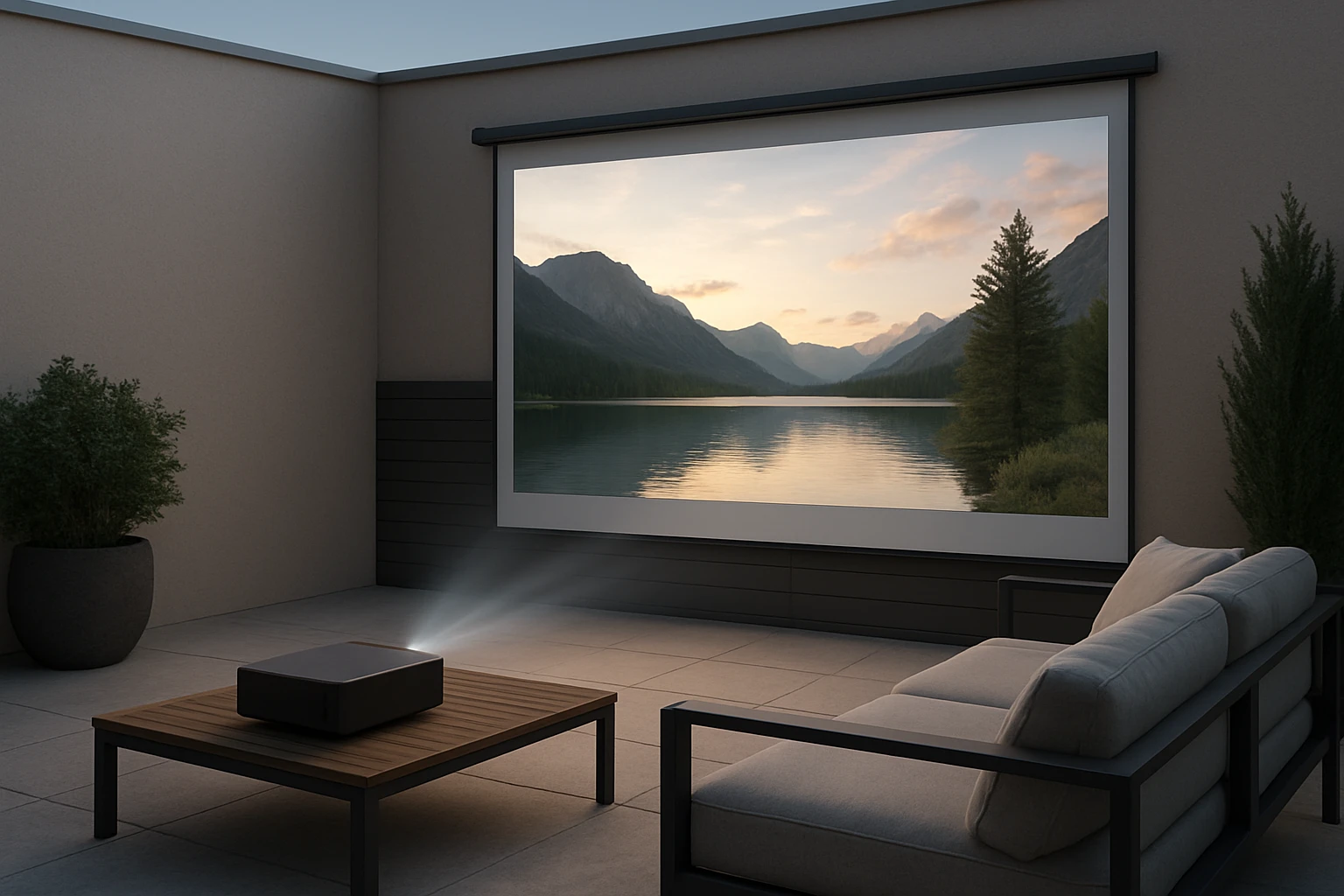
How to Improve Projector Contrast on Your Patio: 10 Ambient Light Hacks for Brighter, Sharper Outdoor Movies
Introduction
Outdoor movie nights have become a popular way to enjoy cinema quality entertainment without leaving the comfort of one\'s home. However, ambient light on a patio can significantly reduce the perceived contrast of a projected image, resulting in washed‑out colors and diminished detail. This guide will teach the reader ten actionable techniques to improve projector contrast in an outdoor setting, explain why each technique works, and recommend specific tools that simplify implementation. By following these steps, the reader will be able to transform a typical patio into a high‑impact viewing arena that rivals a commercial theater.
What You\'ll Need
- High‑brightness projector (e.g., WiMiUS P62 Pro Smart 4K Outdoor Projector)
- Projection screen with high gain and low reflectivity (e.g., HUANYINGBJB 120\" 4K Portable Projector Screen)
- Foldable or stand‑mounted screen for flexibility (e.g., Mdbebbron 120\" Foldable Projector Screen or TOWOND 120\" Projector Screen with Stand)
- Blackout curtains, shade sails, or portable screen dividers
- Directional LED lighting with dimmer control
- Basic tools: screwdriver, measuring tape, zip ties, and cleaning cloth
Step 1: Choose a Projector with Sufficient Brightness
The most fundamental factor influencing contrast on a patio is the projector\'s native luminance, measured in ANSI lumens. A device that can produce at least 800 ANSI lumens will overcome moderate ambient light and preserve deep blacks. The WiMiUS P62 Pro Smart 4K Outdoor Projector offers 800 ANSI lumens, HDR10 support, and a native 1080p resolution with 4K upscaling. At a price of $299.99 and a rating of 4.7 out of 5 stars from 4,283 reviews, it provides a reliable brightness level, built‑in Wi‑Fi 6 for wireless streaming, and dual 10 W Dolby Hi‑Fi speakers that eliminate the need for external audio equipment in many scenarios. Selecting a projector with this brightness ensures that the projected image remains vivid even when some stray light reaches the screen.
Step 2: Use a Dedicated Projection Screen with High Gain
Projector screens are engineered to reflect light more efficiently than a plain wall, thereby increasing perceived contrast. A screen with high reflectivity and a matte surface reduces glare while amplifying the projector\'s output. The HUANYINGBJB 120\" 4K Portable Projector Screen features a high‑reflectivity material, a 120‑inch diagonal size, and a 16:9 aspect ratio suitable for most movies. Priced at $13.99 with a 4.2‑star rating from 1,372 reviews, it is an affordable option that delivers a bright, sharp image and folds flat for easy storage. By using this screen, the viewer benefits from a surface that concentrates projected light, which directly improves contrast in an outdoor environment.
Step 3: Opt for an Anti‑Crease Foldable Screen for Portability
When a permanent screen is not feasible, a foldable screen that resists wrinkles can still provide a uniform reflective surface. The Mdbebbron 120\" Foldable Projector Screen uses anti‑crease polyester fabric that remains smooth after repeated folding, and it includes mounting hooks and ropes for quick installation. At $25.99 and a 4.4‑star rating from 35,227 reviews, it offers a balance between portability and image quality. The anti‑crease property prevents localized dark spots that would otherwise lower contrast, making it an excellent choice for temporary patio setups.
Step 4: Employ a Stand‑Mounted Screen for Stable Positioning
Stability is essential for maintaining a flat projection surface, especially when wind or uneven ground could cause sagging. The TOWOND 120\" Projector Screen with Stand includes a lightweight tripod, crossbars, and a carry bag, allowing the screen to be set up within minutes and positioned at the optimal height. Priced at $69.99 with a 4.5‑star rating from 1,990 reviews, it also features wrinkle‑free polyester milk‑silk material that maintains a uniform reflective plane. A stable screen eliminates distortion that can reduce contrast, particularly at the edges of the image.
Step 5: Install Blackout Curtains or Shade Sails Around the Patio
Ambient light that reaches the screen from the sides or above reduces the difference between the brightest whites and the darkest blacks. Installing blackout curtains on adjacent walls or deploying a shade sail overhead creates a controlled lighting envelope. Heavy‑weight fabrics block sunlight and street lamps, while the sail can be angled to shield the screen without obstructing the projector\'s line of sight. The result is a darker surrounding environment that allows the projector\'s own light to dominate, thereby enhancing contrast.
Step 6: Use Directional LED Lighting with Dimmers
Strategic, low‑intensity LED lighting can improve safety without compromising image quality. Position LED strips behind the seating area or along the perimeter, and set them to a warm color temperature of 2700‑3000 K. Dimmers enable the user to lower the illumination level once the movie begins. Because LEDs emit directional light, they do not spill onto the screen, preserving the black levels that are critical for contrast.
Step 7: Adjust Projector Picture Settings for Maximum Contrast
Modern projectors provide adjustable picture modes, contrast ratios, and color temperature controls. Set the projector to a "Cinema" or "High Contrast" mode, increase the contrast slider to its upper third, and reduce the brightness slightly to avoid washout. If the projector offers a dynamic black or HDR mode, enable it to deepen shadow detail. These adjustments fine‑tune the image to the specific lighting conditions of the patio, ensuring that whites remain bright while blacks stay deep.
Step 8: Add a Mini Bluetooth Projector for Supplemental Content
In some cases, a secondary, lower‑lumens projector can be used for menu navigation, presentations, or background visuals without adding extra ambient light to the main screen. The TMY 1080P Mini Bluetooth Projector costs $49.99, carries a 4.3‑star rating from 19,922 reviews, and includes a portable projection screen. Its compact size and Bluetooth audio capability make it ideal for auxiliary purposes, allowing the primary projector to remain focused on the main movie and preserve contrast.
Step 9: Place a Dark Backdrop Behind the Screen
Even with a high‑gain screen, light that reflects off the wall behind it can lift shadow detail and reduce perceived contrast. Hang a black, non‑reflective fabric or a matte blackout panel directly behind the screen. This creates a “black hole” effect, absorbing stray light and preventing it from bouncing back onto the projected image. The technique is inexpensive yet highly effective, especially in patios where the wall surface may be light‑colored.
Step 10: Perform Regular Maintenance and Lens Cleaning
Dust and debris on the projector lens scatter light, creating a hazy image that diminishes contrast. Use a microfiber cleaning cloth and a lens cleaning solution to wipe the lens before each outdoor session. Additionally, check the projector\'s air filters and replace the lamp or LED module according to the manufacturer\'s schedule. Maintaining optimal optical performance ensures that the projector delivers the full brightness and contrast specifications advertised.
Tips & Pro Tips
- Schedule movie nights after sunset to naturally reduce ambient light.
- Use a laser‑phosphor light source if the budget permits; such sources maintain brightness longer than traditional lamps.
- Align the projector perpendicular to the screen to avoid keystone distortion, which can affect contrast uniformity.
- Consider a portable power inverter with clean sine wave output to prevent flicker caused by unstable outdoor power sources.
- Test the setup with a high‑contrast test pattern before the main feature to verify that black levels are satisfactory.
Troubleshooting
Problem: The image appears washed out even after applying the steps above.
Solution: Verify that the projector\'s lamp has not reached its rated lifespan; a dimming lamp reduces contrast. Check for stray light sources such as nearby LED pathway lights and cover them. Finally, recalibrate the projector\'s color temperature and contrast settings using a calibration disc.
Conclusion
Improving projector contrast on a patio is achievable by managing ambient light, selecting the right screen, and fine‑tuning equipment settings. By following the ten steps outlined in this guide, the reader can enjoy brighter, sharper outdoor movies that rival indoor theater experiences. The recommended products provide reliable tools that simplify each step, yet the techniques remain effective even without additional purchases. Implement these strategies, and every patio gathering will become a memorable cinematic event.
Products Mentioned in This Guide
Frequently Asked Questions
What ambient‑light hacks most improve projector contrast on a patio?
Use blackout curtains or shade sails, position the screen away from direct light, add a portable canopy, and employ low‑glare lighting like LED strips with dimmers.
How does a high‑gain screen boost contrast outdoors?
A high‑gain screen reflects more projector light toward viewers while rejecting ambient light, making colors appear richer and blacks deeper.
Is a higher lumen projector necessary for bright patio settings?
Yes; a projector rated 3000+ lumens ensures the image stays vivid even when some ambient light is unavoidable.
Can portable blackout curtains be used on a patio?
Absolutely—light‑blocking curtains or reflective blankets can be hung around the screen area to create a makeshift darkroom outdoors.
What lighting should I use during outdoor movie nights to preserve contrast?
Opt for low‑intensity, warm‑white LED lights with dimmers placed behind the screen or under the seating area to avoid washing out the picture.